
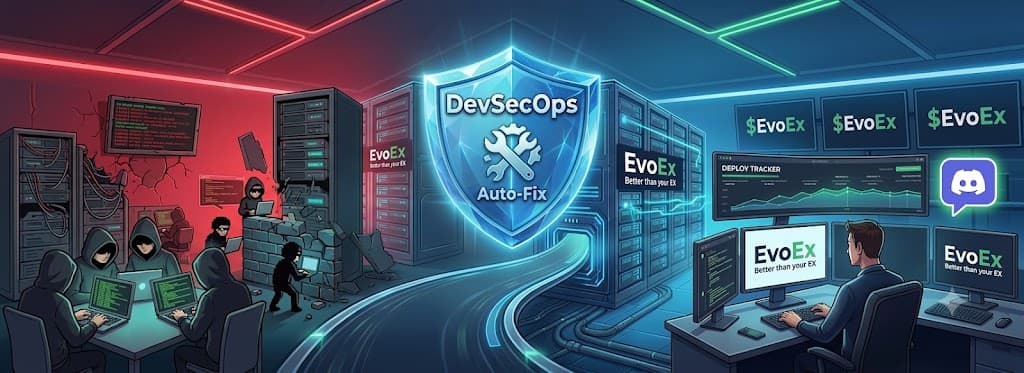
When we at Evoex were planning our infrastructure, we chose a different approach. Rather than waiting and reacting, we aimed to prevent problems from arising in the first place.
Something unforgettable happened in Latvia's IT sector during this year's Midsummer holidays — a cyberattack on the IT infrastructure of Latvia's State Forests. The attack was discovered on June 22, 2026, but it later emerged that the hacker had penetrated the system on June 11 and operated undetected for several days, becoming actively disruptive only during the night of June 22-23.
It reminded everyone working in this field of one simple, but uncomfortable truth: if security is only addressed after something has already happened, it's already too late. Configuration gaps and undiscovered vulnerabilities can remain hidden for extended periods until someone finds them — and unfortunately, that someone is often not the person who should.
When we at EvoEX planned our infrastructure, we chose a different path. Not to wait and react, but to prevent problems from occurring in the first place.
1. Security starts before code reaches the server
In our development process, no change reaches production without comprehensive automated testing. Every piece of new code is analyzed in real-time by specialized security tools built on globally recognized OWASP Top 10 principles — the standard used to detect the most common and dangerous types of vulnerabilities.
If the tools detect even the slightest risk, the change doesn't proceed. The system itself attempts to fix the problematic code section, tests it again, and the process continues until the risk count is precisely zero. Only then can changes reach users.
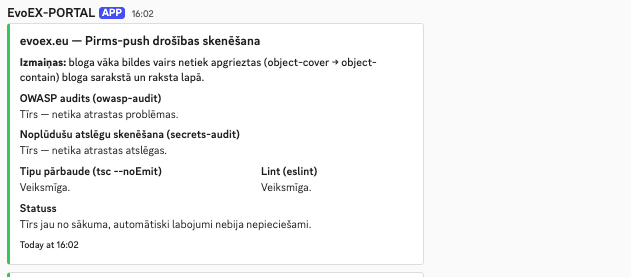
Our team receives this notification every time changes pass through the complete security audit and auto-remediation cycle before deployment.
2. Servers with nothing to lose from the outside
One of the simplest, yet often overlooked security principles — if doors aren't open, they can't be broken into. Our servers run on Hetzner infrastructure, and we've completely closed external access ports traditionally used for remote server access. Instead, the server itself, from within, checks an authorized code repository and, once everything is verified and secure, pulls updates. No one can "knock" from the outside, because there simply are no doors.
Additionally, strict security headers have been implemented on the sites (HSTS, X-Content-Type-Options, X-Frame-Options, Referrer-Policy) that protect users from data interception, site cloning, and other common attack methods.
3. When someone tries anyway
It's impossible to completely eliminate attack attempts — the internet is full of automated bots constantly scanning websites and looking for weak spots. That's why we've built our own system that detects these attempts and responds immediately.
If, for example, a brute-force attempt or suspicious scanning is detected, the attacker's IP address is blocked instantly at the firewall level. But the work doesn't stop there — our custom analytics tool immediately begins investigating what happened: what were the requests, what was their pattern, what did the attacker try to achieve. The result is a concise, clear report that goes straight to our engineering team's Discord channel. This way we not only stop the attempt, but also know exactly what happened.
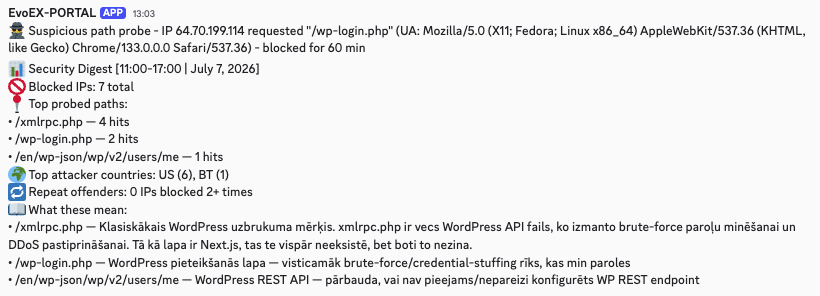
A real example from our system — a suspicious request is blocked immediately, and every hour an automatic summary is generated of all attempts, their origins, and likely intent.
4. What this means for the client
By choosing EvoEx, a client receives far more than just a website or system—they receive infrastructure where security isn't an afterthought, but a foundation.
Errors are found and fixed before they reach the internet, not after something has already happened.
Attack vectors are reduced to a minimum—quite simply, there are no doors to knock on.
The system works and learns continuously, not just once a year when someone remembers to order a security audit.
All updates happen in the background, so your websites and portals continue running without interruption.
Cybersecurity isn't a process you can "set up once and forget about." It's continuous work. And we believe—the less our clients have to worry about it, the better we're doing our job.
5. Why we're talking about this
We didn't build all of this because someone asked us to. Over the past year, we've invested thousands of euros to construct and continue developing this system—time, tools, and proprietary software we developed that runs in the background without interruption, every single day.
This isn't a one-off investment you can check off and forget—it's infrastructure we continue to invest in because we know that attackers' methods evolve faster than most companies can respond.
The LVM case demonstrated that even large enterprises with substantial resources can lack exactly this—a system that detects problems before they become a crisis.
We didn't wait for something like that to happen to us or our clients. We've invested time and money to build infrastructure that's resilient from the ground up, not just when someone starts looking for who to blame after an incident.
This means that a client who chooses EvoEx doesn't have to worry whether their data and systems are protected as an afterthought. Security isn't an add-on service you can bolt on later—it's already built into every project we create.
If you'd like to understand how your website or system's security looks from the outside, reach out—we'll evaluate it together and tell you honestly where the risks are and what to do about them.
Book your audit—EvoEx Audits from 390 EURO
Related services
Ready to start your project?
Tell us about your idea — we'll email you a proposed time for a video call to discuss the details and prepare a quote.